


Why More WordPress Users Are Moving to Gutenberg Instead of Traditional Page Builders
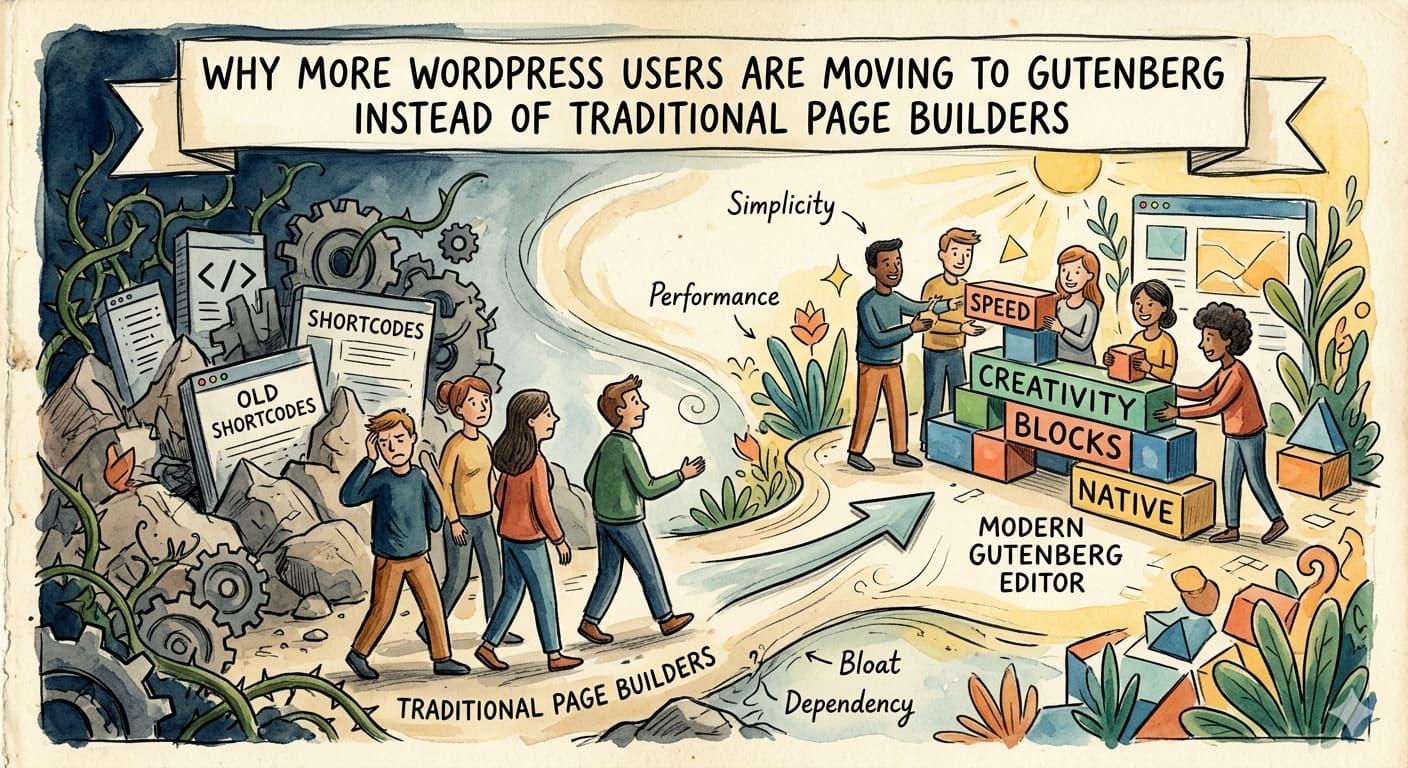
Why More WordPress Users Are Moving to Gutenberg Instead of Traditional Page Builders
Gutenberg is no longer “the future” of WordPress. It has already become the standard. Developers, agencies, bloggers, and business owners are slowly leaving heavy page builders behind and adopting the native block editor for performance, flexibility, and long-term stability.
The Big Shift Happening Inside WordPress
For years, page builders dominated WordPress. Tools like Elementor, WPBakery, Divi, and Beaver Builder made it easy for non-coders to create modern websites with drag-and-drop editing. They solved a real problem during a time when WordPress editing felt outdated and restrictive.
But things changed when WordPress introduced Gutenberg — the block editor. At first, many users hated it. It felt unfinished, confusing, and limited compared to mature page builders.
Fast forward to today, and the situation is completely different.
Gutenberg has evolved rapidly. Full Site Editing, reusable blocks, patterns, global styles, and modern themes have turned it into a serious website-building system. Now developers and site owners are asking an important question:
“Why use a heavy third-party page builder when WordPress itself can already do the job?”
1. Website Speed and Performance Matter More Than Ever
One of the biggest reasons users are moving away from page builders is performance.
Traditional page builders often load extra CSS, JavaScript, animations, and DOM elements — even when they are not needed. This creates bloated pages that slow down websites.
Google now heavily prioritizes Core Web Vitals, mobile speed, and user experience. A slow website hurts rankings, conversions, and engagement.
Gutenberg produces cleaner code because it is built directly into WordPress core. The result is lighter pages, faster load times, and better SEO performance.
Why This Matters
- Faster websites rank better on Google
- Lower bounce rates improve user engagement
- Mobile visitors stay longer on optimized sites
- Less bloated code means easier maintenance
2. Gutenberg Is Becoming the Default Future of WordPress
This is the reality many people ignored for years:
Gutenberg is not a plugin anymore. It is the foundation of modern WordPress.
WordPress core development is now deeply focused on blocks, Full Site Editing, patterns, and native customization.
That means themes, plugins, tutorials, hosting companies, and developers are increasingly optimizing for Gutenberg first.
Many agencies are moving toward block-based development because it aligns with the long-term direction of WordPress itself.
3. Gutenberg Gives More Freedom to Developers
Developers often dislike page builders because they can become restrictive.
While drag-and-drop systems look simple, they sometimes generate messy structures behind the scenes. Advanced customization can become difficult, especially when working on large websites.
Gutenberg, on the other hand, works closer to native WordPress architecture. Developers can create custom blocks, dynamic layouts, reusable components, and lightweight systems without depending heavily on third-party ecosystems.
React-based block development is also attracting modern JavaScript developers into the WordPress ecosystem.
4. Page Builder Lock-In Is a Serious Problem
One painful issue with page builders is lock-in.
If someone builds an entire website using a specific builder and later decides to remove it, the site can break badly.
Shortcodes remain everywhere, layouts collapse, and content becomes difficult to clean.
Gutenberg avoids much of this problem because content is stored more cleanly inside WordPress itself.
The Industry Is Learning a Hard Lesson
Relying too much on third-party ecosystems can become risky over time. Native WordPress solutions usually survive longer because they evolve with WordPress itself.
5. Modern Gutenberg Themes Look Surprisingly Good
Many people still think Gutenberg websites look plain or basic.
That was true in the early days.
But modern block themes have improved dramatically. Themes like GeneratePress, Kadence, Blocksy, Spectra One, and Frost now offer highly professional layouts with excellent performance.
Combined with block plugins, Gutenberg can now build landing pages, business sites, blogs, portfolios, SaaS pages, and even advanced WooCommerce stores.
6. AI and Gutenberg Work Well Together
AI tools are changing content creation rapidly.
Gutenberg’s block structure fits naturally into AI-assisted workflows because content is modular and organized.
AI-generated sections, layouts, FAQs, feature grids, pricing tables, and content blocks can easily integrate into block-based editing.
This is one reason many modern WordPress SaaS products are focusing heavily on Gutenberg integrations instead of older page-builder ecosystems.
Does This Mean Page Builders Are Dead?
No. Not at all.
Page builders still have advantages:
- Faster visual design workflows
- Large template libraries
- Beginner-friendly interfaces
- Strong marketing page builders
- Advanced visual effects and animations
Elementor especially still dominates a huge part of the WordPress market.
But the direction is changing. Many new websites are now starting directly with Gutenberg because users want simplicity, speed, and long-term stability.
Final Thoughts
The shift toward Gutenberg is not just about trends.
It reflects how WordPress itself is evolving.
People want faster websites, cleaner code, fewer dependencies, and systems that remain stable for years.
Gutenberg is finally reaching the point where it can compete seriously with page builders while offering the advantages of being native to WordPress.
The Bottom Line
Page builders helped WordPress evolve during an important era. But Gutenberg represents where WordPress is heading next. The people moving early are betting on performance, flexibility, and the future of native WordPress development.
Проверенные пользователи

 Russian
 English
 Arabic
 French
 Spanish
 Portuguese
 Deutsch
 Turkish
 Dutch
Dutch
 Italiano
 Romaian
 Portuguese (Brazil)
 Greek
Greek
