


How to Get Started with Building Automation for Small Buildings
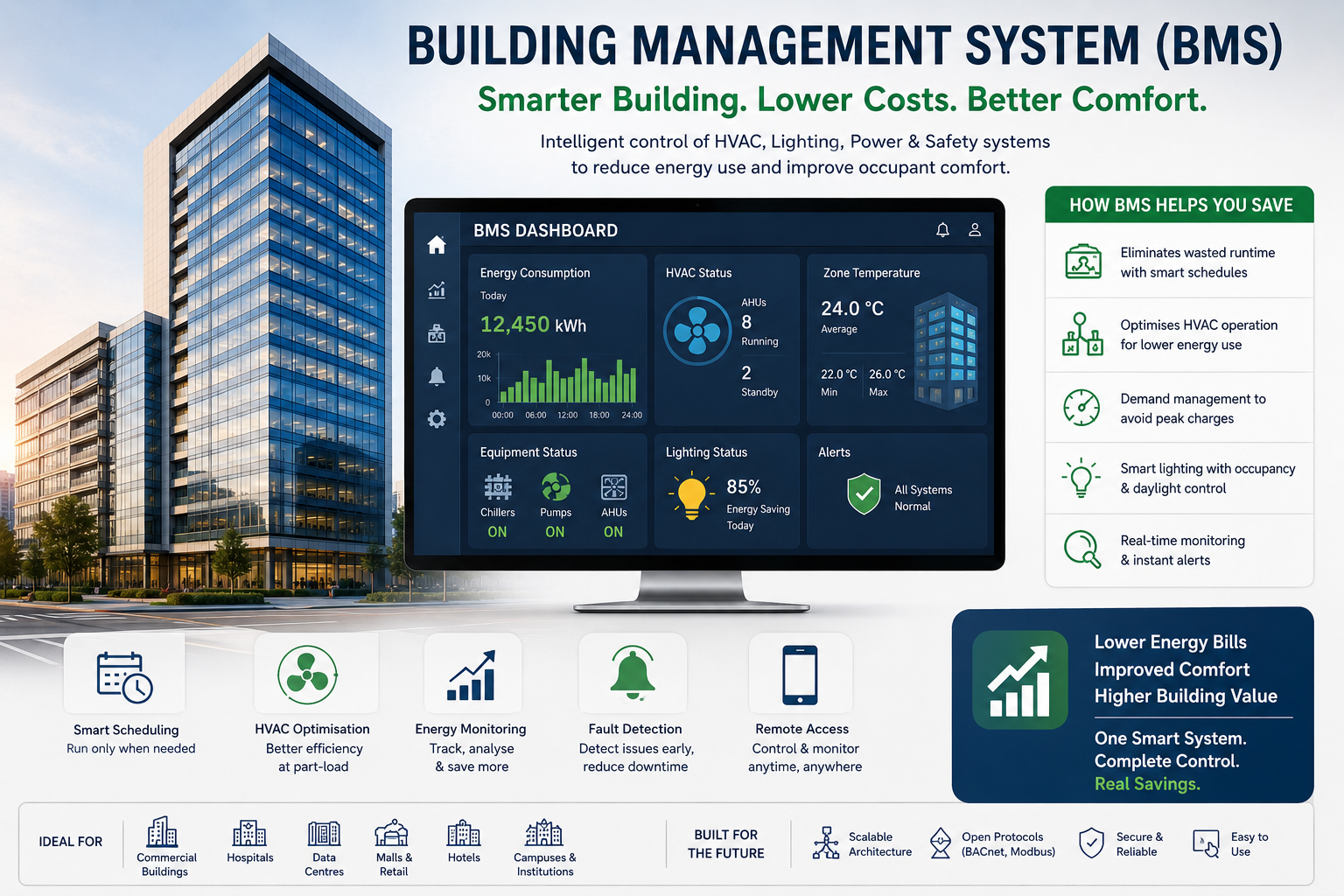
Imagine the facilities manager of a six‑floor commercial block in Ghaziabad: rising electricity bills, inconsistent air‑conditioning on busy floors, and tenant complaints about lighting schedules. For small buildings, these symptoms signal opportunity—automation can bring measurable energy savings and improved occupant comfort without enterprise‑scale budgets. This guide explains how to get started with building automation and what a practical Building Management System delivers for compact sites
A Building Management System is no longer exclusive to skyscrapers and data centres. For small commercial buildings, hotels, clinics and educational campuses, a right‑sized BMS reduces utility cost, enforces regulatory compliance and simplifies operations. Within the first steps, owners must prioritise clear scope, control points and scalable architecture so the system grows with the building’s needs.
What a Building Management System is and how it works
At its core, a BMS monitors sensors, executes control logic and presents data to operators. Field devices — thermostats, VAV controllers, lighting sensors, meters — feed a BMS control panel or distributed controllers. The supervisory software aggregates trends, issues alerts and allows schedule or setpoint adjustments. Modern small‑building solutions often blend local controllers with cloud dashboards for remote monitoring and simplified commissioning.
Practical starting steps for small buildings
- Conduct a site audit: map HVAC assets, lighting circuits, electrical panels, fire interfaces and access points; count potential control points.
- Define objectives: energy reduction targets, occupant comfort thresholds, peak‑demand limits, or remote monitoring needs.
- Choose a scalable architecture: distributed controllers with a lightweight supervisory HMI or a compact integrated controller with cloud capability.
- Specify protocols: prefer open standards (BACnet, Modbus) to avoid vendor lock‑in and to ease future integrations.
- Plan commissioning: include sensor calibration, functional tests and schedule validation. Proper SAT reduces rework and optimises performance.
HVAC automation, lighting and power monitoring
For small buildings, HVAC and lighting offer the fastest ROI. Simple automation sequences—optimized chiller staging, VAV scheduling, night setback, and demand‑controlled ventilation—cut loads significantly. BMS lighting control systems using occupancy sensors and daylight harvesting reduce lighting energy and maintenance overhead. Add sub‑metering for feeders to track energy per tenant or zone and to identify abnormal consumption.
Integration with safety and security
Even compact installations benefit from integrating fire alarm signals, access control and CCTV event status into the BMS for coordinated responses. A BMS may receive fire inputs to release HVAC dampers or initiate safe shutdowns, while access control integration helps align HVAC schedules with occupancy profiles for additional savings.
Remote access, alerts and analytics
Remote dashboards and push alerts are essential for small teams. Real‑time alarms for equipment faults or energy spikes allow technicians to act before tenant complaints escalate. Cloud‑assisted analytics can surface seasonal trends, provide fault detection and enable predictive maintenance, which is especially valuable where on‑site engineering resources are limited.
Key features to expect in a small‑building BMS
- Scalable system architecture for phased upgrades.
- HVAC monitoring and control with scheduling and basic PID loops.
- Energy consumption tracking via sub‑metering and interval logging.
- Real‑time alerts and mobile notifications for faults.
- Remote access and mobile compatibility for offsite management.
- Multi‑system integration capability through open protocols.
- User‑friendly dashboards for operators and building owners.
- Predictive maintenance support where analytics are available.
- Low maintenance hardware and modular design for easy replacement.
- Reliable 24/7 operation with simple redundancy options.
Applications suitable for a compact BMS
Compact BMS deployments work well in small commercial offices, clinics, boutique hotels, educational buildings, branch data center rooms, retail outlets and small industrial facilities. Even residential high‑rise podiums and smart city pilot buildings can use lightweight BMS strategies to improve energy profiles and occupant wellbeing.
System selection factors for small buildings
When evaluating providers, weigh building size and control point count, type of desired architecture (fully on‑prem vs cloud‑enabled), and integration needs. Compare software licensing models and commissioning support. After‑sales support and BMS maintenance services are critical—small owners rely on responsive AMCs and clear SLAs. Prioritise lifecycle value: spare‑part availability, firmware update policies and ease of expanding control points.
Buyer’s guide for Indian projects
Select a BMS company with local engineering presence, documented project references and open‑protocol expertise. Verify testing and commissioning practices, training availability, and AMC options. Confirm compatibility with industry standards (BACnet, Modbus) and the vendor’s experience with similar facilities. For retrofit projects, require a clear plan for wiring, network segmentation, and minimal disruption during installation.
Common mistakes to avoid
- Skipping a proper building assessment before choosing controls.
- Picking systems without scalability or open protocols.
- Underestimating integration complexity between HVAC, lighting and power.
- Choosing solely on upfront price rather than lifecycle costs.
- Failing to plan for maintenance and staff training.
- Ignoring cybersecurity for remote access.
- Not defining energy KPIs before deployment.
- Rushing commissioning and poor handover documentation.
A practical link for project planning
When scoping a project, detail the expected deliverables for BMS system installation and insist on FAT/SAT procedures and training to ensure smooth handover. For technical references and services tailored to Indian projects, review established provider offerings for structured installation and maintenance pathways.
Conclusion
Getting started with building automation for small buildings means focusing on a compact, scalable Building Management System that delivers HVAC and lighting control, energy metering, safety integrations and remote monitoring. Prioritise open protocols, rigorous commissioning and reliable after‑sales support to maximise lifecycle value. A well‑engineered BMS reduces energy costs, improves occupant comfort and provides the operational visibility every small facility needs to run efficiently and safely.

 English
 Arabic
 French
 Spanish
 Portuguese
 Deutsch
 Dutch
Dutch
 Italiano
 Russian
 Romaian
 Portuguese (Brazil)
 Greek
Greek
