

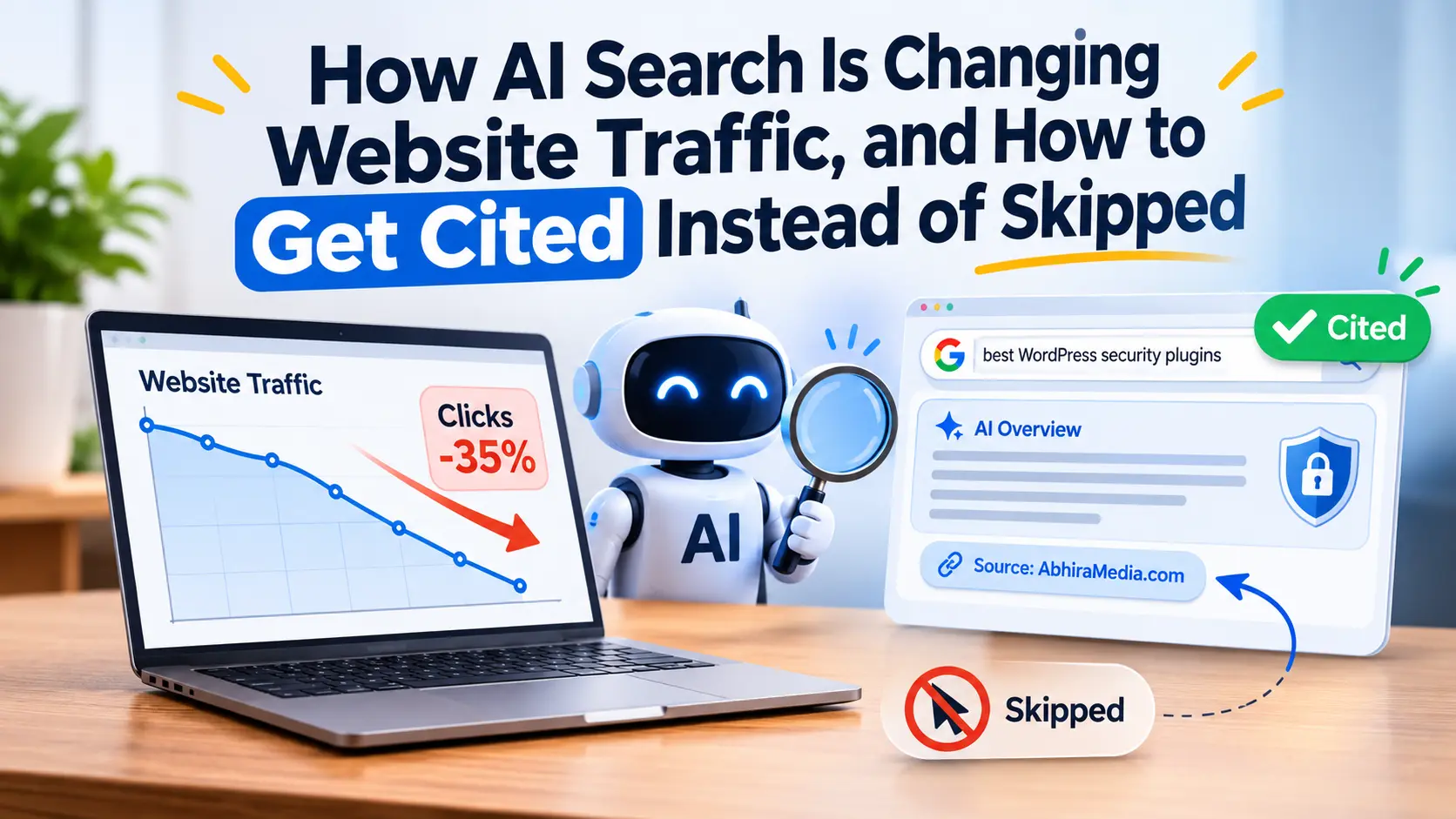
How AI Search Is Changing Website Traffic, and How to Get Cited Instead of Skipped

For years, getting traffic from Google followed a fairly familiar pattern. Someone searched for a question, looked through the results, clicked a website, and read the answer. If your content was useful and your website ranked well, you had a reasonable chance of earning that visit.
People are increasingly encountering AI-generated answers directly in search results and using tools such as ChatGPT to research products, troubleshoot technical problems, compare services, and understand unfamiliar topics. Instead of opening five different websites, they may read a summary and move on.
For website owners, this creates an uncomfortable question: if search engines and AI tools can answer questions without sending visitors to the original source, what happens to the websites that produce the information?
The answer is not as simple as saying that SEO is dead. Search still matters, but visibility is becoming more complicated. A website may need to do more than rank in a list of blue links. It also needs to provide information that search engines and AI systems can understand, trust, and potentially reference.
For publishers and businesses, the challenge is to remain useful when the search experience itself is changing.
The Traffic Problem Is Real, but the Picture Is More Complicated
Imagine you run a website publishing WordPress tutorials, cybersecurity research, or software reviews.
You spend several hours investigating a problem, testing a solution, and writing a detailed article. A few years ago, someone searching for that problem might have clicked your article to find the answer.
Today, an AI-generated response might explain the same issue directly on the search page. The user gets enough information to move forward without visiting your website.
This is particularly noticeable with informational searches. Questions such as “What is schema markup?”, “How do I fix a WordPress error?” and “What is the difference between two JavaScript frameworks?” can often be answered in a few paragraphs.
However, not every search behaves this way. Someone researching an expensive software subscription, comparing hosting providers, looking for a reliable developer, or investigating a security incident may still need detailed evidence, independent testing, pricing information, and expert advice.
The objective is not simply to attract more visitors. It is to attract the right visitors and give them a reason to choose your website.
A smaller number of relevant visitors can be more valuable to a business than a large volume of traffic from people who leave without taking any meaningful action.
Why Publishing More Articles Is No Longer a Reliable Strategy
For a long time, many websites followed a straightforward content strategy: identify keywords, publish articles around those keywords, build links, and try to improve rankings.
That approach can still have a place, but publishing dozens of articles that repeat information already available across the internet is becoming a weak competitive advantage.
AI systems can summarise widely available information quickly. If your article contains nothing beyond familiar definitions, generic advice, and information that readers can find everywhere else, there may be little reason for someone to visit your website.
Consider two articles about improving WordPress security.
The first explains that website owners should use strong passwords, install security plugins, keep WordPress updated, and enable two-factor authentication.
The second investigates how an outdated plugin handles user permissions, demonstrates the vulnerability in a controlled test environment, explains the conditions required to reproduce it, and provides a verified fix.
Both articles discuss WordPress security, but they offer very different levels of value. The first provides general knowledge. The second provides evidence, practical experience, and information that may be difficult to obtain elsewhere.
What Does It Mean to Get Cited by an AI Search System?
When an AI-powered search experience produces an answer, it may refer to external websites as sources. Some experiences display clickable citations alongside the answer, while others provide summaries without a prominent link to every source.
Getting cited can introduce your website to readers who might never have encountered it through a conventional search result.
However, there is an important distinction: being cited by an AI system is not guaranteed, and there is no universal technique that forces a website to appear in AI answers.
Different systems retrieve information differently. Their behaviour can also change over time. The practical goal is to make your website easier to discover, understand, verify, and reference.
1. Publish Information That Comes From Real Work
One of the strongest ways to make an article useful is to include something that cannot be produced simply by summarising common advice.
For a technical website, this might mean testing a WordPress plugin before recommending it, measuring page performance before and after a change, or documenting a bug that appears only under specific conditions.
For a business website, it could mean publishing an original customer case study, explaining how a service works in practice, or comparing real project outcomes.
For a technology publication, it might involve testing a product, examining a software update, interviewing an engineer, or investigating a security issue using reliable evidence.
When you perform a test, explain the environment, the method, the result, and any limitations. If a result applies only to a particular version of a plugin or configuration, say so.
Do not invent test results, customer experiences, survey findings, or traffic statistics to make an article appear more authoritative. Originality is valuable only when it is genuine.
2. Make the Answer Easy to Find Within the Article
A common problem with technical content is that readers must work too hard to find the information they need.
A better approach is to answer the central question early and then explain the reasoning.
To improve your chances of appearing in AI-generated search answers, publish accurate and original information, make important facts easy to identify, maintain accessible technical pages, and provide clear evidence for your claims. These practices improve discoverability, but they cannot guarantee a citation.
Use descriptive headings, meaningful paragraphs, numbered instructions where appropriate, and tables when they genuinely help readers compare information.
For technical tutorials, include working code, prerequisites, version requirements, expected output, and troubleshooting notes. Detailed explanations still matter. The goal is to make important information easy to locate without sacrificing depth.
3. Use Structured Data, but Understand What It Can and Cannot Do
Schema.org provides a vocabulary for describing information on a page in a format that supported systems can interpret. On websites, this is commonly implemented through JSON-LD.
A technology article might use Article or BlogPosting schema to describe its headline, author, publication date, and modification date.
A business website might use an appropriate Organization or LocalBusiness type. A product page may use Product when its content meets the relevant requirements.
Here is a simplified JSON-LD example for an article:
<script type="application/ld+json">
{
  "@context": "https://schema.org",
  "@type": "BlogPosting",
  "headline": "How AI Search Is Changing Website Traffic",
  "description": "A practical guide to AI search visibility, original content and technical SEO.",
  "datePublished": "2026-11-03",
  "dateModified": "2026-11-03",
  "author": {
    "@type": "Organization",
    "name": "AbhiraMedia"
  },
  "publisher": {
    "@type": "Organization",
    "name": "AbhiraMedia"
  },
  "mainEntityOfPage": {
    "@type": "WebPage",
    "@id": "https://abhiramedia.com/your-article-url/"
  }
}
</script>
This is an illustrative example. Replace the dates with the article's actual publication and modification dates, and replace the example URL with the article's canonical URL. The author and publisher details must reflect the real publishing arrangement.
For WordPress, check whether your SEO plugin or theme already generates this markup before adding another implementation. Duplicate or contradictory schema can create unnecessary problems.
Most importantly, structured data is not a shortcut to AI citations. It helps describe a page's content and relationships, but it does not guarantee indexing, enhanced search results, rankings, or inclusion in an AI-generated answer.
4. Build Trust Into Every Important Claim
If your website publishes information about cybersecurity, software vulnerabilities, business services, or product performance, readers need to understand where the information came from and how reliable it is.
- Identify the author or responsible editorial team.
- Include publication and modification dates where relevant.
- Link to primary documentation, official announcements, research papers, and other appropriate sources.
- Distinguish confirmed facts from assumptions and opinions.
- Explain testing methods when making performance or security claims.
- Correct outdated information when software versions, prices, or recommendations change.
These practices help readers assess your work and create a clearer information environment for search systems that evaluate and retrieve content. There is no single trust signal that guarantees AI visibility. Trust is built through consistent, verifiable publishing practices.
5. Stop Treating Every Search Visitor as the Same Kind of Customer
A website can receive thousands of visitors without generating meaningful business. This is why site owners should reconsider how they organise their content around search intent.
Informational
Example: “What is website schema markup?”
The reader wants an explanation. A clear guide, examples, and related resources may be enough.
Commercial investigation
Example: “Best WordPress maintenance services for agencies.”
The reader is comparing options and needs credible comparisons, service details, limitations, and pricing information where available.
Transactional
Example: “Hire a WordPress security consultant in India.”
The reader may be ready to contact a provider. They need to understand the service, experience, scope of work, and how to get in touch.
An AI summary may satisfy some informational searches before the user visits your website. But a well-prepared service page, detailed comparison, or original case study can still be valuable when the reader needs to make a decision.
For businesses, this means building a website that supports the entire customer journey rather than relying exclusively on high-volume informational keywords. The next step should help the reader, not simply push them towards a sale.
6. Measure Whether AI Search Is Affecting Your Website
It is easy to become concerned about AI search after reading industry reports or seeing discussions about declining organic traffic. But your own website data is more useful than general speculation.
Start with Google Search Console and your website analytics platform.
In Search Console, examine organic clicks, impressions, click-through rate, average position, and the queries bringing people to your pages. Compare similar periods and account for seasonal changes, publishing activity, and ranking fluctuations.
If impressions remain stable while clicks fall, one possible explanation is that the search result is attracting fewer clicks. However, that pattern alone does not prove that AI-generated answers caused the decline. Changes in ranking, competition, search features, and query mix can also affect click-through rate.
In your analytics platform, examine landing pages, engaged sessions, referral sources, and meaningful conversions. For a business website, track enquiries, purchases, sign-ups, and other outcomes that matter commercially.
Also look for identifiable referrals from AI tools in your analytics reports. Referral visibility varies by platform, and some visits may not be attributed cleanly. A missing referral does not necessarily mean that an AI system never mentioned your website.
For a practical analysis, create a baseline before changing your content strategy. Record the performance of important pages, identify the search queries they target, and note any relevant changes you make. Review the results over time instead of drawing conclusions from a few days of data.
7. Do Not Neglect the Technical Foundations of Your Website
Content quality cannot compensate for a website that search engines struggle to access.
Check that important pages return the correct HTTP status codes, are not unintentionally blocked by robots.txt, and do not contain accidental noindex directives. Verify that canonical URLs point to the intended versions of your pages.
Make sure your XML sitemap contains the URLs you want search engines to discover. Review internal links so important pages can be reached through ordinary HTML links. Ensure that the main content is available to supported crawlers and is not hidden behind an interaction they cannot use.
Page performance, mobile usability, and a sensible site structure remain important parts of a sound technical foundation.
It is also worth understanding the difference between search crawling and AI-specific access. Some AI-related crawlers serve different purposes, including search retrieval and model training. Their identities, behaviour, and controls vary by provider.
If you want your content to be available to a particular service, consult that provider's current documentation before changing crawler rules. Do not assume that allowing or blocking one bot automatically controls every AI search experience.
8. Give Readers a Reason to Visit After They Have Seen the Answer
This is arguably the most important part of the discussion.
If a person can get everything they need from a short AI-generated answer, there may be no reason to click your article. No schema implementation or clever heading structure can change that basic reality.
Your website must offer something that the summary does not.
- A working code example or interactive tool.
- An original dataset or downloadable checklist.
- A detailed product comparison based on actual testing.
- A reproducible experiment or investigation.
- A specialist's explanation of an unusual problem.
- A detailed case study that demonstrates a real outcome.
For a WordPress development publication, a useful article could include a small plugin that demonstrates the solution, explain why a common implementation fails, and provide a tested alternative.
For a technology publication, it could include independent product testing, evidence from a security investigation, or an interview that provides context unavailable in the manufacturer's announcement.
These are not merely ways to improve search visibility. They are reasons for a reader to value your website in the first place.
A Practical 30-Day Plan for Website Owners
You do not need to rebuild your website or publish fifty new articles to begin adapting. Start with a small number of important pages and work methodically.
Week 1: Establish the Baseline
- Identify your ten most important organic landing pages.
- Record their clicks, impressions, click-through rates, and relevant conversions.
- Select a few important search queries for manual visibility checks.
- Identify pages with declining performance or high impressions but weak click-through rates.
Week 2: Improve the Content
- Update outdated facts, screenshots, code, and product information.
- Add original examples, testing notes, or useful evidence where possible.
- Rewrite vague headings so readers can understand what each section covers.
- Move the central answer closer to the beginning of the article.
Week 3: Review Technical SEO
- Validate existing structured data and remove conflicting implementations.
- Check indexing, canonical URLs, internal links, and sitemap coverage.
- Review mobile usability and page performance.
- Read current documentation for relevant search and AI services.
Week 4: Measure and Refine
- Compare performance against the baseline.
- Review relevant referral traffic and business conversions.
- Check whether updated pages are being indexed and whether their search visibility has changed.
- Record what worked, what did not, and what needs more time.
Thirty days is enough to establish a disciplined process and identify early signals. It is not enough to guarantee that search rankings, traffic, or AI citations will improve. Indexing and ranking changes may take longer, and individual results will vary.
The Future Belongs to Useful Websites, Not Just Searchable Websites
AI search is changing the relationship between publishers and their audiences. Search engines and AI assistants can now provide answers that once required a visit to an external website, and that creates real pressure for publishers whose business models depend on advertising or organic traffic.
Pretending that nothing has changed would be a mistake. But abandoning SEO altogether would be another one.
Websites still have a role to play in providing original reporting, reliable technical documentation, independent testing, specialist knowledge, and services that people need. The challenge is to make those strengths visible and accessible in a search environment that increasingly answers questions before a visitor reaches the source.
For website owners, that means combining solid technical SEO with original work, clear explanations, verifiable claims, and a better understanding of business outcomes.
For developers, it means building websites that are accessible, well-structured, and useful to both people and automated systems.
For business owners, it means measuring enquiries and sales rather than treating every pageview as a success.
And for publishers, it means resisting the temptation to produce more of the same content simply because a keyword tool suggests demand.
You cannot control whether an AI system cites your website. You can control whether your website offers something worth citing.
That is where the work should begin.
Editorial note: AI search features, crawler policies, and referral reporting vary across providers and change over time. Verify current platform documentation and use your own website data before drawing conclusions about traffic or citation performance.


