

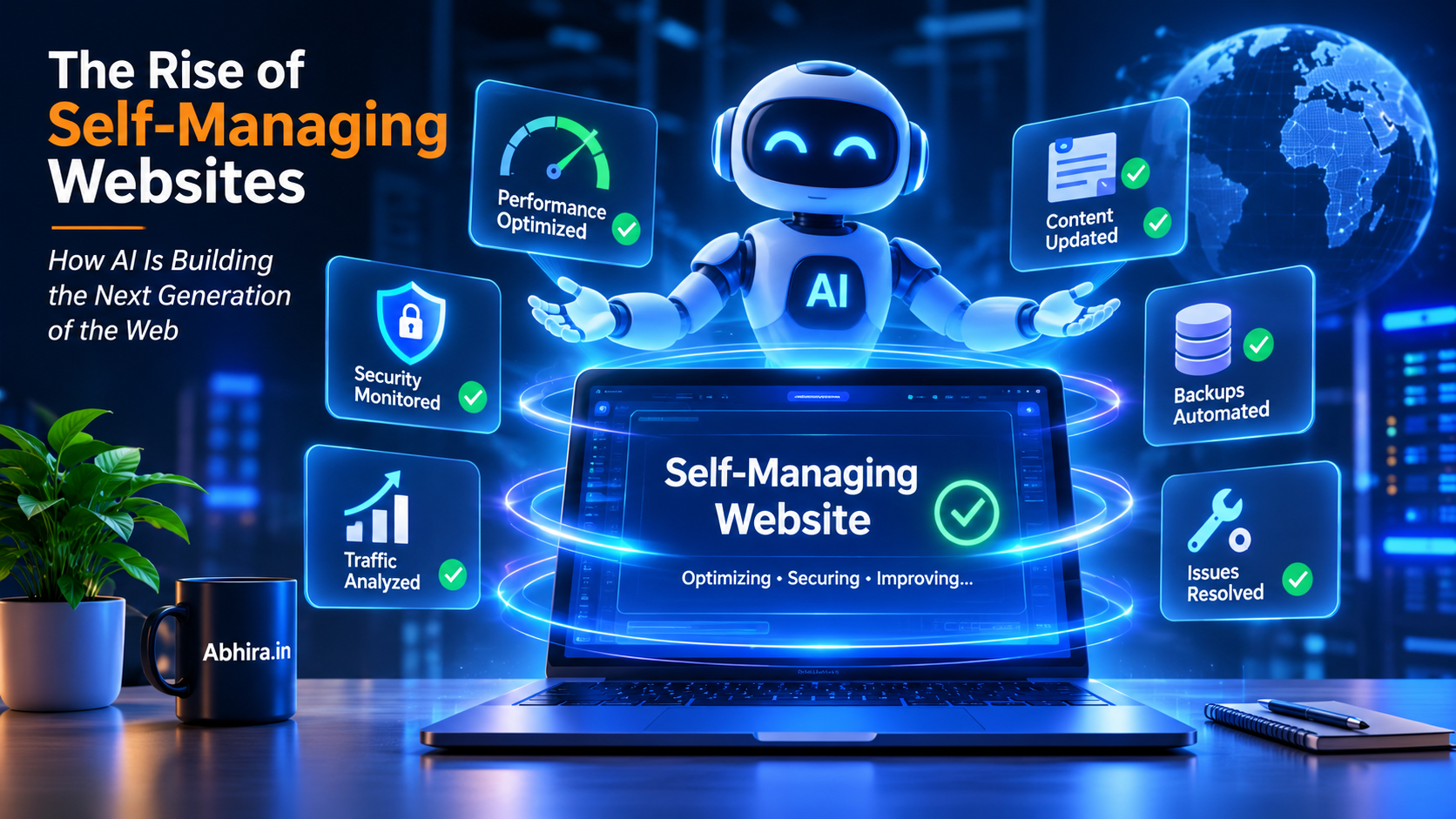

Imagine a website that detects its own problems before visitors notice them, automatically fixes broken links, improves page performance, identifies suspicious activity, updates outdated content, and continuously optimizes the user experience — without requiring an administrator to perform every task manually.
This is the direction in which modern web technology is heading. Websites are gradually evolving from manually managed digital properties into intelligent systems capable of monitoring their environments, making decisions, and performing specific tasks autonomously.
Artificial intelligence is accelerating this transformation. What once required developers, hosting administrators, security specialists, and content managers may increasingly be handled through coordinated AI systems and automated workflows.
Inside This Article
01. From Traditional Websites to Intelligent Systems 02. What Is a Self-Managing Website? 03. Technologies Powering Autonomous Websites 04. What Can a Website Manage Automatically? 05. How Does the System Work? 06. The Future of WordPress 07. Challenges and Limitations 08. What Comes Next?01. From Traditional Websites to Intelligent Systems
For decades, websites have followed a relatively simple management model. Developers build the application, administrators maintain its content, hosting providers manage infrastructure, and security tools protect against common threats.
Every important change generally requires human involvement. Someone needs to review an error, investigate a performance issue, install an update, check backups, or modify content.
Automation has already reduced some of this workload. Scheduled backups, automatic updates, caching, monitoring systems, and deployment pipelines have made website management easier.
However, conventional automation usually follows predefined instructions. It performs a task when a particular condition is met, but it does not necessarily understand the wider context or determine the best response.
AI introduces a different possibility. Intelligent systems can interpret operational data, identify patterns, analyze potential causes, and recommend or execute actions within predefined permissions.
02. What Is a Self-Managing Website?
A self-managing website is a digital platform that uses automation, monitoring, artificial intelligence, and predefined policies to maintain and improve its own operations.
Instead of waiting for an administrator to identify every problem, the system continuously evaluates its condition and responds to supported situations.
It is important to understand that self-managing does not mean completely independent or uncontrolled. The website operates within permissions, security rules, approval processes, and recovery mechanisms established by its owners.
Continuously checks availability, performance, errors, and system health.
Identifies opportunities to improve loading speed and user experience.
Detects suspicious behavior and applies approved security responses.
Automates routine maintenance, backups, checks, and reporting.
03. Technologies Powering Autonomous Websites
Artificial Intelligence and Large Language Models
Large language models can interpret instructions, analyze technical information, summarize errors, generate code suggestions, and help administrators understand complex problems.
When connected to authorized website tools, AI systems can also initiate workflows such as content reviews, troubleshooting procedures, and maintenance tasks.
AI Agents
AI agents take automation further by combining reasoning, tools, instructions, and multi-step workflows. An agent may investigate a failed website request, collect relevant logs, identify a likely cause, and recommend a solution.
With suitable permissions and testing, some agents can perform approved corrective actions without requiring manual intervention at every step.
Predictive Analytics
Predictive systems analyze historical and real-time data to identify patterns that may indicate future problems. For example, unusual increases in server response time may indicate an emerging capacity issue.
Automation and API Integrations
APIs allow different website services to communicate. Monitoring platforms, hosting infrastructure, content management systems, security applications, and deployment tools can work together through controlled integrations.
Observability and Event Processing
Logs, metrics, traces, and system events provide the information required to understand website behavior. An intelligent management system uses these signals to identify abnormal conditions and trigger appropriate workflows.
04. What Can a Website Manage Automatically?
1. Intelligent Performance Management
A self-managing website could monitor page loading times, database response times, caching performance, resource usage, and Core Web Vitals.
Based on approved policies, it could clear outdated caches, identify oversized images, recommend database optimization, or adjust selected performance settings.
2. Automated Security Monitoring
Security is one of the most promising applications of autonomous website management. Intelligent systems can analyze login patterns, identify suspicious requests, detect unusual traffic, and monitor software vulnerabilities.
Depending on the level of authorization, the system could temporarily restrict suspicious sessions, notify administrators, or initiate an incident response workflow.
3. Content Intelligence
Websites often contain outdated information, broken links, duplicate pages, and incomplete content. AI-assisted content management can identify these issues and help editorial teams maintain accuracy.
It could also identify outdated technical documentation, suggest internal links, and recommend improvements to existing articles. Publishing should still follow editorial review policies.
4. Automated Error Detection and Recovery
Imagine a website experiencing a sudden increase in server errors. A monitoring system detects the issue, collects logs, identifies the affected service, and starts an approved diagnostic procedure.
Depending on the situation, it might restart a failed service, roll back a recent deployment, or alert the administrator. Critical database and application changes should require additional safeguards.
5. Intelligent User Experience
AI can analyze user interactions and identify areas where visitors experience difficulties. For example, it may discover that users frequently abandon a particular form or struggle to locate important information.
The website could recommend navigation improvements, accessibility corrections, and form usability enhancements.
05. How Does a Self-Managing Website Work?
A practical self-managing architecture can be divided into several connected layers. Each layer has a specific responsibility.
Collects uptime, application errors, performance metrics, security events, and system logs.
Analyzes collected information using rules, statistical models, and AI.
Evaluates permissions, policies, risk levels, and the appropriate response.
Runs authorized tasks through APIs, scripts, integrations, and automation tools.
Checks whether the action solved the original problem without creating new issues.
Uses historical outcomes and feedback to improve future recommendations and policies.
Consider a practical example. A website begins loading significantly slower than usual. Its monitoring layer detects the performance change and sends relevant information to the intelligence layer.
The system analyzes recent changes and identifies a potentially problematic caching configuration. The decision layer checks whether the proposed action is permitted. The execution layer applies the approved correction, and the verification layer measures the result.
If the correction fails, the system can restore the previous configuration and notify the administrator.
06. The Future of WordPress: From CMS to Intelligent Website Platform
WordPress powers a substantial part of the internet. Its flexibility, plugin ecosystem, REST API, and extensible architecture make it an interesting foundation for intelligent website management.
Today, WordPress administrators commonly manage plugins, themes, updates, backups, security, content, and performance through separate tools and interfaces.
The next generation of WordPress tools could bring these capabilities together through a unified AI-powered management layer.
What Could an AI-Native WordPress Website Look Like?
- Intelligent plugin management: Detect compatibility risks and recommend safer update strategies.
- Autonomous security operations: Identify suspicious behavior and initiate controlled security responses.
- Performance intelligence: Monitor website speed and suggest or execute approved optimizations.
- Content maintenance: Find outdated articles, broken links, and missing information.
- Website health reports: Generate understandable reports covering technical health and maintenance.
- Recovery automation: Use verified backups and rollback procedures when approved changes fail.
Rather than installing multiple disconnected plugins, website owners could eventually manage many operational functions through a single intelligent control center.
07. Challenges and Limitations
Although the idea is promising, fully autonomous website management is not a solved problem. Giving software the ability to change a live website introduces serious responsibilities.
Security and Permissions
An AI system with unrestricted administrative access could accidentally damage a website or expose sensitive information. Permissions must follow the principle of least privilege.
Incorrect Decisions
AI models can misunderstand situations or produce incorrect recommendations. High-impact operations should not rely on an AI-generated decision alone.
Testing and Rollback
Every automated change should be validated. Backups, staging environments, version control, audit logs, and rollback mechanisms are essential components of a reliable system.
Human Oversight
Not every decision should be automated. Financial transactions, deletion of important data, major infrastructure changes, and sensitive security decisions should have appropriate human approval.
08. What Comes Next? The Autonomous Web
The internet is gradually moving toward more intelligent and connected systems. AI agents, automation frameworks, APIs, and predictive technologies are creating new possibilities for how websites operate.
In the future, a website may be able to coordinate different specialized agents. One agent could monitor security, another could manage performance, while a third could maintain technical documentation.
These agents could share information through a common management platform and coordinate their activities according to the website owner's policies.
Website owners may spend less time performing repetitive maintenance and more time focusing on business strategy, customer relationships, product development, and innovation.
This future will not arrive overnight. It will develop through incremental improvements in automation, observability, AI reasoning, software integration, and security engineering.
Conclusion: Websites That Work for Themselves
Self-managing websites represent an important direction in the evolution of the internet. By combining artificial intelligence, autonomous agents, monitoring systems, and controlled automation, websites can become more responsive, efficient, and easier to maintain.
The goal is not to remove developers or administrators. It is to reduce repetitive work and give professionals better tools to manage increasingly complex digital systems.
The most successful websites of tomorrow may not simply be the ones with the best design or fastest servers. They may be the ones capable of continuously understanding, maintaining, and improving their own digital environments — while keeping humans in control of important decisions.
The future of the web is not just intelligent websites. It is websites that can intelligently take care of themselves.


